“The history of the Port of Koper is inseparably linked to its people – to generations of employees who, during times of rapid development, built the foundation of our shared system with their enthusiasm, perseverance, and dedication. Over the decades, the way we work has changed significantly, technology has advanced and processes have evolved. Yet one thing remains constant: the need for skilled, responsible, and committed professionals who understand and share the port’s development vision,” said Nevenka Kržan, President of the Management Board of Luka Koper, in her opening address to yesterday’s event.
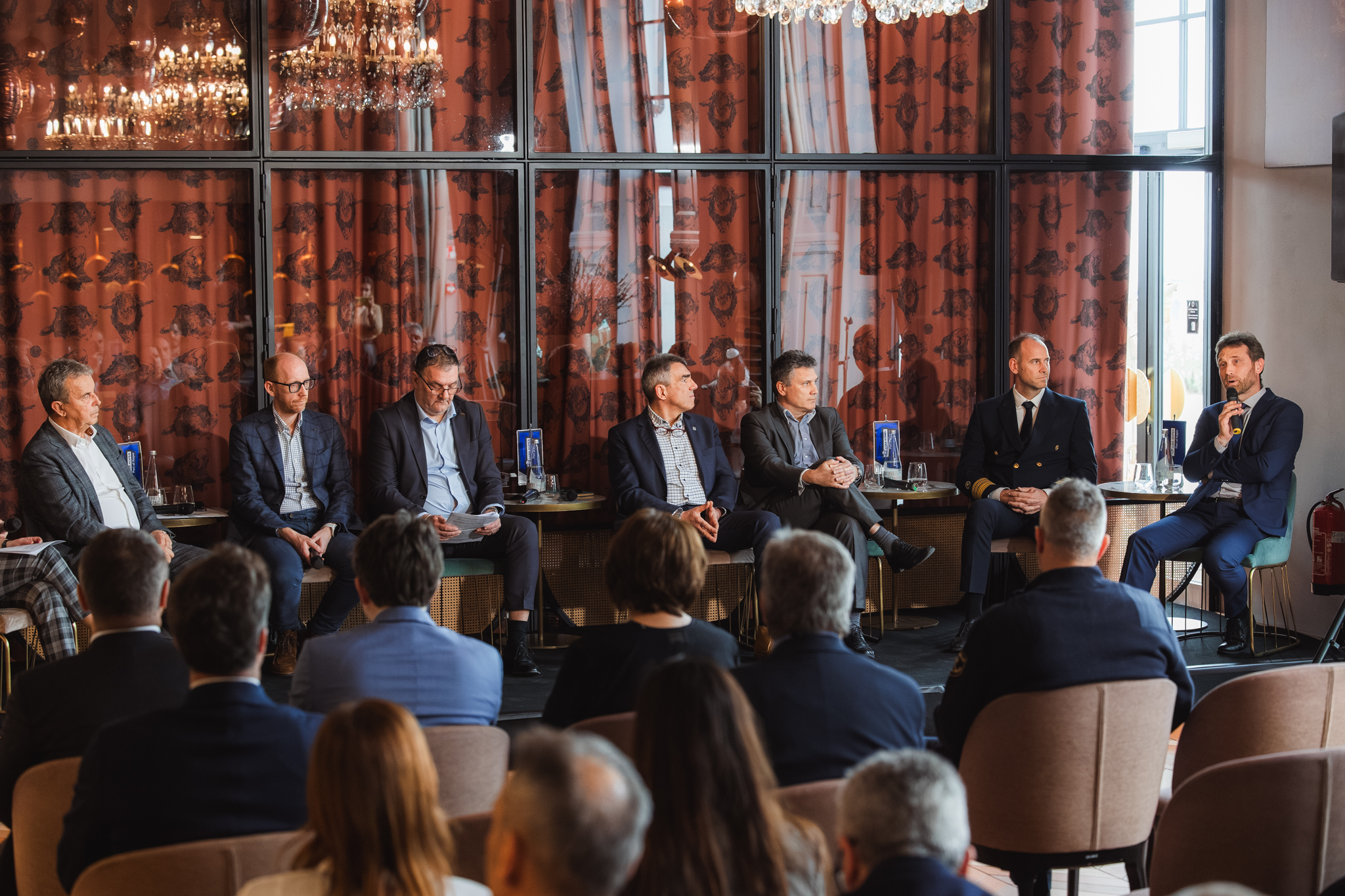
The panel discussion that followed brought together a diverse group of experts: Tomaž Pečnik, Director of the Directorate of Aviation and Maritime Transport at the Ministry of Infrastructure; mag. Jadran Klinec, Director of the Slovenian Maritime Administration; Vojko Rotar, Workers’ Director and Member of the Management Board of Luka Koper; dr. Peter Vidmar, Dean of the Faculty of Maritime Studies and Transport in Portorož; Borut Butinar, Principal of the Piran Grammar School and Secondary School for Electrical Engineering and Maritime Studies; Čedomir Bojanić, President of the Transport Association (Port Forwarders Section); and Gracijan Necmeskal, President of the Slovenian Ship and Freight Agents Association. The discussion focused on key issues concerning the long-term resilience of the maritime and port system – one that relies not primarily on infrastructure or technology, but on people.
Dean of the Faculty of Maritime Studies and Transport dr. Peter Vidmar highlighted the importance of cooperation between the education sector and industry: “Education must keep pace with the needs of the economy and the trends that may not yet be directly embedded in it. What matters most is that, as a faculty, we build a vertical line of knowledge. Our students come from diverse backgrounds, with some already bringing prior experience in maritime studies or logistics.” He added that the faculty must, within only a few years of study, meet international standards while also adapting to highly specific industry needs. Continuous adjustment and close cooperation with nearby businesses are therefore essential. His view was shared by Borut Butinar, Piran Grammar School and Secondary School for Electrical Engineering and Maritime Studies: “Interest in maritime professions remains high, as confirmed by steady annual enrolment. What has changed is the motivation – today’s youth are attracted to maritime careers primarily because of the opportunity to work in an international environment. They are also drawn to digitalization and automation, which are increasingly shaping the maritime and logistics sectors. It is crucial that the state, or the ministry, ensures a clear career pathway after graduation, offering students real employment opportunities. Most importantly, secondary school students should be able to envision and plan their career path from the very beginning.”
Tomaž Pečnik, Director of the Directorate of Aviation and Maritime Transport, agreed on the need for a systemic approach and the creation of conditions that would allow those wishing to pursue a maritime career to do so: “The Ministry of Infrastructure is actively seeking ways to address this issue. The challenge lies in the fact that Slovenia does not have a national shipping company – a situation similar to that in aviation. I believe that, with the support of the competent ministry, as well as collaboration with the faculty and secondary school for maritime studies, we will find a solution to ensure that those who aspire to become seafarers will have that opportunity. We must start by gathering data to clearly define the real needs of the sector and, at the same time, have a clear vision of what we want to achieve.”
The Slovenian Maritime Administration is also facing challenges, in some cases even being forced to lower professional standards. Director Jadran Klinec emphasized that they have been dealing with a shortage of properly certified personnel for many years: “The knowledge that students acquire in schools and universities is excellent; however, during recruitment we often encounter restrictions imposed by the Employment Relations Act.”
Sharing his perspective on the issue, and emphasizing that the company’s strong growth can only be sustained with an adequate staffing structure, Vojko Rotar, Workers’ Director and Member of the Management Board at Luka Koper, stated: “In recent years, we have increased our workforce from 950 to around 2,500 employees, which means we have almost exhausted the pool of available human resources. Early signs of staff shortages can already be seen across all professional levels – operational, specialized technical, and strategic-development positions. We have therefore been compelled to introduce our own training programs to build key competencies. It is for this reason that last year we opened a new training center, which also includes a virtual reality simulator. In this way, we are creating a kind of training ground that is both innovative and attractive to our future employees.”
Čedomir Bojanić, President of the Transport Association (Port Forwarders Section), offered an example of how the shortage of specialized knowledge could be addressed: “In major systems and advanced logistics countries such as Belgium and the Netherlands – both traditionally important and comparable to us – this challenge has been solved by establishing academies alongside secondary and university education to transfer specific, practical expertise. Employers have observed that secondary school students and university students possess a solid foundation of general knowledge, but often lack the specialized skills that only hands-on experience can provide.”
Gracijan Necmeskal, President of the Slovenian Ship and Freight Agents Association, also addressed the issue of attracting young people: “Maritime agencies are constantly adapting to changes within the industry, but candidates who have completed specialized maritime education certainly have an advantage here. Today’s generations have different career priorities and expectations compared to those of the past. The real challenge arises when experienced professionals retire – how to replace them. We could lower professional standards, but that is not a sustainable solution, as it would inevitably reduce quality. We will need to find a more long-term solution in a relatively short timeframe.”
The discussion raised several key points, highlighting the need for the education system to keep pace with industry needs, identifying the main challenges in training and providing practical experience for young seafarers, while emphasizing the importance of ensuring that Slovenia continues to maintain the knowledge and competencies essential for the future development of the maritime and logistics sectors.
The participants agreed that, in addition to completing practical training and mandatory cadetship, one of the greatest challenges lies in how to motivate and inspire younger generations to pursue maritime and key logistics professions – careers that demand significant dedication and years of training. As Tomaž Pečnik emphasized in conclusion, the state has made several important decisive steps over the past year – both through the initiative to establish a national shipping company and by setting up a fund to finance mandatory practical training for seafarers.